Dr. Gail Brenner

Sacred Space for Awakened Living

TwitterYoutubeFacebookGoogle +
  • Home
  • About
    • About Gail
    • Start Here
    • Testimonials
    • Professional Bio
  • Read
    • Blog
    • Archives
    • Friday Inspiration Newsletters
    • Guest Posts
  • Watch
  • Listen
    • Downloadable Guided Meditations
    • Interviews
    • Calm Center Online Conversations—Recordings
  • Events
  • Work with Me
  • Books
    • Suffering Is Optional
    • At the Core of Every Heart
    • The End of Self-Help
    • The End of Self-Help—Guided Audio Meditations
  • Contact

Will These Memories Ever Go Away?

memory

“History, despite its wrenching pain, cannot be unlived, but if faced with courage, need not be lived again.”
Maya Angelou

Will these memories ever go away? This question came from a friend who recently learned that her father was dying. The news led her to reminisce about her childhood – and she was caught off guard when long-gone memories reappeared with unexpected emotional force.

She wrote, “As much as I feel like I have dealt with it…do you ever really fully deal with all the pain and discomfort that you felt??”

Probably each of us have asked this question at one time or another, so it deserves some exploration. If what we want is to live in freedom, in the aliveness of now, we are invited to investigate any experience that takes us away. When we realize that the past affects how we function in the present, we can take a deep and compassionate look – and unravel the knot so we can be free of it.

Memories Are Not the Problem

Memories of past events are not the problem; the problem – and the opportunity – is our emotional reactions to them. I recently experienced a white Christmas in Scotland, which brought back wonderful memories of snowy winters in Pennsylvania, where I grew up. But when I think about my father losing his temper or my best friend who died when we were in high school – my reactions are quite different.

Memories are problematic when we continue to experience emotional residue from them. This happens when the emotional reactions we had at the time the events occurred were not completely finished or resolved. Consequently, they still color our current relationships and views of ourselves, other people, and situations.

Things get complicated as we try to cope with these unresolved feelings. We find ourselves defending and strategizing to deal with them, and we feel confused, overly emotional, and unfulfilled. It’s just like having an elephant in the room that you aren’t willing to see. The fact that the elephant is there affects everything you think and do, yet you are not directly addressing the elephant’s presence.

Emotional Wounds Don’t Exist

Some people describe their unresolved past experiences as an emotional wound. Certainly, the degree of pain that is sometimes experienced feels like a wound.

If this is how you view the reactions to your memories, I invite you to embark on an inner exploration, with laser vision, to see if you can find the wound. A careful look will reveal no such thing. You might see strong, painful emotions, constrictions in your body, or disturbing images in your mind, but no actual wound.

Who you are – your original, natural state – is whole, integrated, spacious, and unaffected by your history. What seems like a wound is, in reality, a story we run in our minds and difficult emotions that lodge in our bodies – nothing more and nothing less.

Telling yourself you are wounded is, first of all, not true, and second, impedes the process to reclaim your natural state of freedom and wholeness.

Why Do I Feel So Bad?

Once we recognize these emotional reactions to past memories, it’s time to celebrate: we have the chance to let go of the ball and chain we have been unknowingly carrying around. Here is how these entanglements develop:

  • An event or series of events happen – something traumatic, an ongoing difficult relationship.
  • You have an emotional reaction to the event – fear, sadness, anger, disappointment, grief.
  • You don’t completely experience the emotions, so they go underground. This could occur for several reasons – the feeling is too painful so you avoid it, you are told it is unacceptable, you don’t know how to deal with it, you don’t have enough of the support you need.
  • A world view evolves based on these unresolved feelings. Examples are: I’m not good enough; I need to control other people; I’ll only be liked if I do what others want me to do; I can’t commit to anyone or anything; I need to avoid conflict.
  • Our lives end up being fueled by these unexplored emotions and distorted perspectives. They may be active most of the time and define who we are or be triggered by specific situations and people that remind us of the past.

Does this sound familiar?

We have taken a part of our experience, deemed it unacceptable, and banished it from our awareness. If you think of yourself as a handful of precious jewels, it’s like taking the exquisite ruby and burying it in the dirt.

This is the process that breeds addiction, interpersonal difficulties, low self-esteem, chronic stress, and many other problems that interfere with our happiness and satisfaction in life.

The Pathless Path

We know that the emotional residue is gone, that we are free of the power of these challenging memories, in two ways. First, we have the memory without a strong reaction, and second, the areas of our lives that have been held hostage by these hidden feelings begin to flow once again.

As you begin to investigate these emotional reactions, the goal is simply to open yourself wholeheartedly to the exploration. It is completely understandable that you want to feel better. And it is likely that you will feel better as you directly experience these emotions. But this is a side effect.

The only reason to investigate emotions is to know yourself, to lovingly receive what is present in your experience, because it’s there. It is a part of your reality. What happens as a result is not your business. Your job is very simple – to allow your experience to be as it is.

Investigating with the intention of feeling better is not accepting things as they are. With this mindset, you are agreeing to investigate what is happening as long as the experiences dissipate. This bargaining is resistance to what is actually present and ultimately strengthens the emotions.

Steps to Freedom

Now, putting on your explorer’s headlamp…take your time as you go through the following steps. Lean into the memory and its effects on you and know that every moment of awareness is a moment of freedom.

  1. Tell the story of what happened. If you haven’t already, let yourself remember the events of the past. Rather than thinking about them, tell a good friend what happened or write it down. Know that there will be a last time you tell this story – maybe this is it! Eventually, it won’t trigger you.
  2. Take responsibility for your reactions. I cannot say this too many times, as it is at the core of realizing happiness and freedom. When you let go of blaming others, you put an end to being a victim. Terrible things may have happened, but your recovery is in your hands only.
  3. Acknowledge the feelings that could not be expressed when the events occurred. Find the most loving space inside you, and feel the pure terror, rage, or grief without telling yourself a story about them. Bring your attention to your body and experience the physical sensations that accompany these emotions. If this step is very difficult for you, consider talking to a counselor who can hold a space for you to be with these feelings.
  4. Illuminate your belief systems. See how avoiding these feelings has affected how you see the world. Do you tend to be pushy, passive, withdrawing, melancholy, anxious, or needy? Do you see other people as threatening, controlling, or as objects to be manipulated? These perspectives are the likely effect of unexplored feelings about relationships from your past.

Once the emotional reactions to these challenging memories are seen, they begin to lose their power over you.

Will These Reactions Ever Go Away?

It is absolutely possible for the memories to appear as an occasional whisper in your mind without any associated pain or trauma. Whether or not this will happen for you is not for me to say. What I do know for sure is that every time you recognize and welcome your reactions, you are a little more free of them. If you consistently see them all the way through, they eventually diminish.

My friend who inspired this post was surprised to discover that her feelings were still very strong. Working with painful memories is like peeling the layers of an onion. As the emotional residue is seen and resolved, deeper levels of blocked feelings may be revealed.

Remember that the goal is not to be rid of all the feelings. This is a pathless path – it is going nowhere except right here to what is present in this moment. Your job is just to be with what is.

If you are resolute in your desire for freedom, you may be motivated to make a list of all the memories that still catch you. Become aware of your emotional reactions to all of them and identify how these feelings have influenced the way you see yourself and others.

Be with everything, always, as it is, and you are free…alive…open…one with life.

Clear out all the cobwebs, and you can’t help but shine brilliantly.

Love to each and every one of you….

image: ThroughMy Eyes

Lessons from My Time in Prison

“When I hear somebody sigh, ‘Life is hard,’ I am always tempted to ask, ‘Compared to what?'”
Sydney J. Harris

I know, it’s a dramatic title, but it’s been an interesting few days. From nowhere, a cloud has appeared, and I find myself stuck – imprisoned by my habits. Old mental tendencies have surfaced, and I am moody and negative.

Enduring happiness? Absolutely possible, I know, but right now it feels covered over by a film of sadness and disconnection. Or does it? Even as I write this, my experience is changing, with clarity reemerging.

Life is so generous – it has brought me another tremendous opportunity for learning how unhappiness works. It’s time to take my own advice. As my partner told me, “You have all the tools and understanding. If anyone can find their way out, you can.”

All the signs are there: I feel like a victim of circumstances and other people. I feel powerless. I am sad and irritable. Sounds like being stuck in a pattern to me.

The funny thing is that when I look with clear vision, nothing has changed. No momentous events have happened. I haven’t been broken up with or diagnosed with cancer or excommunicated from the human race.

The only thing that has changed is the thoughts in my mind. Yes, it’s true – it’s all in my head. I say that not to dismiss my experience, but to point the way to the way out.

I love how life has a sense of humor. How ironic – and humbling – that this reaction descends just as I have completed the series of posts on Freedom from the Prison of Your Habits. Well, I guess I have more to say, so here, from the trenches, is what I am discovering about opening the prison door.

Not taking responsibility = Stuck

I’ve said this before, but it bears repeating. Sanity requires us to take responsibility for our own reactions. The thoughts of blaming others and “if only” fantasizing may be incredibly powerful. They run through our minds like a command of soldiers on a mission compelling us to do what? Actually, nothing. If these thoughts are in control, we are standing firmly in a belief system that is waiting for everyone and everything else to change. This gets us nowhere.

The world is not going to give you everything you want on a silver platter. No matter how forceful the habitual thoughts that beckon us to look outside ourselves for happiness, the wisest part of us knows that we need to look within.

In the past few days, I have repeatedly turned my attention away from the dead end thoughts and inward to investigate what is actually true. The thoughts kept grabbing me, and I kept returning within…over and over.

Get the right support

No one is coming to save you. The journey to peace is yours and yours alone. Certainly, get help if you need it, but do it wisely.

Support from others can be either medicine or poison, as one of my teachers describes it. Here is the poison: sitting on the phone telling the story of your woes and justifying your positions ad nauseum. If you are speaking with someone who completely agrees with your distorted way of thinking, you will stay stuck.

And here is the medicine: speaking with someone who is clearer than you in that moment and won’t buy into the negative misleading thoughts. It might be a therapist or mentor or friend you respect. This person will gently challenge you and offer an evenhanded perspective that brings clarity to your confused mind.

During my days of captivity, I spoke to two very sympathetic friends. I loved that they understood my point of view. But it wasn’t until I had a conversation with someone else, who was brutally honest about what he saw, that things began to shift. What made this work is that I was at least a little open (i.e., not defensive) to hearing what he had to say.

Be aware of your inner experience

On this blog, I speak a lot about investigating thoughts and welcoming emotions. I did follow my own advice during this time. It was sometimes difficult to be with painful feelings without the story starting up, but I did my best. It felt much more sane to allow the sadness and irritation to be, to feel them in my body, than to let the story run. Although I could justify the stories, I eventually found them to be lifeless and distracting.

And I was reminded that becoming familiar with what I was experiencing does not necessarily mean that my experiences would dissolve. Becoming aware of what is true in our experience has no goal. It is simply being with what is.

Of course you want to feel better. What I found is that the tools I used helped, but ultimately things shifted in their own time. I did all the preparations, but the actual letting go was not something I personally controlled.

I don’t have a strong inner critic, so there wasn’t a lot of self-judgment happening. In a certain sense, I was going with the flow. But if you tend to self-criticize, realize that there is another layer of thought that may be disorienting you.

You don’t always get what you want

A few days into this whirlwind, I got to the core of the problem: what I want vs. what I am given. I was caught in wanting people around me to be a certain way and to want certain events to happen that weren’t happening. My mind got very detailed about what it did and did not want.

When I looked at reality, I really saw: people are the way they are and the events I was waiting for were not occurring. I didn’t have any control to make anything different. Somehow this insight penetrated the insanity, and the dust began to clear.

Here are the choices I considered: change the situation, leave it, or realize that the problem is in how I was thinking about it. I did what I could reasonably do to change the situation, and I chose not to leave. What remained, then, was the task of coming to peace with things as they are. This sounds like a great idea, but it is only helpful if it lands and you experience an inner letting go.

Take care of yourself

It was no secret that I was having a hard time, so I did a number of things that helped to ease the pain. I didn’t force myself to work more than I wanted to. I went to a party I wasn’t too keen on, but ended up having a good time. I didn’t blow my diet or drink too much alcohol. I kept up with yoga and relatively normal hours of sleeping. And I knew my sympathetic friends were on call if I needed a little TLC.

One of the good things about hard times is that you get to be really nice to yourself. Think of it like a sick day. Take a rest, watch a movie, be out in nature, get support. Don’t coddle yourself to the point of reinforcing the drama, but take care of your body and enjoy yourself a little.

The cloud moves on

The clouds are parting, and the sun is shining once again. I am very grateful for this experience because, when I think about it, I have learned so much: avoiding pain perpetuates it ; negative thoughts with lots of energy behind them are misguided; even though you deeply know peace and happiness, delusion happens; there is definitely light at the end of the tunnel.

I feel sane again…open, happy, loving, clear, expansive. And nothing has changed, but my mind! The veils have fallen away, and the boundaries are dissolving. All I can say is “thank you” – for every single moment of it.

How do you fare when you find yourself stuck? Any insights you’d like to add?

image credit: NicholasT

Freedom from the Prison of Your Habits #5: Feeling the Body

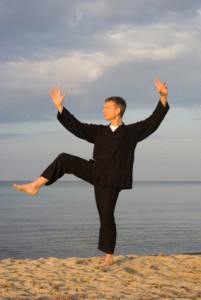
tai chi - posture kick with right heel“Few of us have lost our minds, but most of us have long ago lost our bodies.”
Ken Wilbur

This post marks the fifth and last in the series Freedom from the Prison of Your Habits. The previous posts are:

  • Part 1: How Habits Develop
  • Part 2: Identifying Habits
  • Part 3: Examining Thoughts
  • Part 4: Letting Emotions Surface

Here we bring our attention into the body, a place few of us know very well. Yet the body contains the residue of all our learning, all experiences, traumas, fears, conditioning. Whereas our minds may defend and avoid, our bodies are simple, reactive, and all-knowing. They have been present our entire lives absorbing the effects of our experiences.

Habits invariably show up as contractions in the body. In our natural state, prior to any conditioning, our bodies are open vessels through which our individual life stream is expressed. You can see it in infants who move with such openness and flexibility.

As we experience physical, mental, and emotional demands in life, stress takes its toll and the body begins to close down. These bodily contractions act like a defensive shield, armoring us to meet the challenges we face in the world. Presence is the peacemaker.

How to Be Aware of the Body

The final step to fully exploring a habit is to bring attention to the specific experiences in the body that accompany the habit. The method is simple: become aware of the body. Begin at the top of the head, at the toes, or at the strongest physical sensation. Be like a laser to discover all the tiny tensions, contractions, vibrations, and flutterings everywhere.

Make space for whatever you notice, allow it to be as it is, then micro-observe into the sensation even deeper to uncover layers of ancient holding. I guarantee you will be surprised at what you find. To paraphrase songwriter John Mayer, your body is an absolute wonderland.

Whether sensations change, release, strengthen, or disappear is out of your control. There is no goal other than welcoming experiences as they are. This is “being with” and “allowing,” not doing. These sensations are, they exist. You are simply making space to receive them in your awareness.

As you do, you are lighting up the hidden areas of your being. If each of these sensations had a voice, what would they be saying? Maybe they would be expressing terror, despair, frustration, or rage. By opening your heart to them and inviting them into conscious awareness, you are allowing them to speak in their own unique way. And in the seeing of them without resistance, there is peace. Fragments are embraced, and we are revealed as whole once again.

If you carry on observing physical sensations directly, you will eventually experience a release. Some people laugh, some sob, some go quiet, some jerk or vibrate. Breathing may change. You might feel a physical weight lifting off you. You may need less sleep for a while. Energy is being released, and you are reclaiming the natural state of openness, unimpeded joy, and deep relaxation.

Practices for Body Awareness

Since most of us are relatively unfamiliar with our physical selves, practices that support body awareness can be very useful – and enjoyable.

Conscious breathing

“When you inhale, you are taking the strength from God.
When you exhale, it represents the service you are giving to the world.”
Yoga master B.K.S. Iyengar

One of the wonders of life in this body is the regularity of our breathing. Simply bring your attention to the specifics of breathing – the inhale and the exhale. The breath affects so much more than the chest and lungs. Discover the ripple effects of the breath in all parts of the body…just being curious about how the breath moves.

You might notice you feel more relaxed as you pay attention to your breathing, and the breath itself might shift in some way. Simply continue to be aware of every sensation.

Conscious breathing is a gateway to intentionally relaxing the body. This practice can help you to discover and release habits held in the body.  After a few minutes of noticing the breath, begin to deepen the breathing. Relax the belly as you exhale completely, then see how the inhale expands the chest and ribs and opens the upper back. Taking a few deep breaths, filling and emptying the lungs, brings presence into previously hidden areas of the body. The flow of oxygen calms the nervous system and releases muscular tension.

Gratitude practice for the body

Considering what you are grateful for is a beautiful heart-opening practice. You might consider including gratitude for the functions of the body. When we investigate the body, we become aware of an amazing, relentless propensity for life.

So much of what it takes to be alive in the body happens automatically – breathing, digestion, filtering toxins, renewing cells, fighting disease. You might take some time to bring your attention to the organs – heart, brain, kidneys, spleen, liver, colon, stomach – and inner workings of the body that work so hard to support life. As you become aware of each one, open your heart with gratitude and appreciation.

Movement practices

Most of you don’t know me personally, but those who do know that yoga is my thing. I’ve been practicing for 11 years, and to me, the experience of yoga is endlessly fascinating. Movement practices such as yoga, tai chi, chigong and others bring awareness to the body and promote presence by synchronizing movement with breathing. They invite the attention into the here-and-now by ignoring mind chatter and focusing directly on the arisings in the moment.

My lovely friend Ellen offers a practice you can stream on video called The Body of Presence. (Click on “yoga,” then “Body of Presence.”) She has a beautiful way of allowing movement to illuminate how habits are held in the body and giving space for them to dissolve naturally.

Movement practices also teach us how to be present in daily life. Moving into a yoga posture is no different from washing the dishes, taking a walk, dancing, etc.

Conclusion: Freedom From the Prison of Your Habits

This marks the end of the series on Freedom from the Prison of Your Habits. The key to the prison door is awareness. If what you want is to know happiness intimately, to reclaim the peace that is your true nature, unlock the door by deeply exploring your thoughts, feelings, and bodily sensations. As each layer of experience is seen, the tendency to replay the habit softens.

The urge to enact the habit may occur, but your awareness is so revealing, your understanding so clear, that you choose a different way of responding. This may not happen the first time you turn your attention inward and away from the habit, but I promise you that as you continue to be aware of your experience in the moment, the momentum of the habit will diminish.

Every moment of awareness is cause for celebration. We all have direct knowledge of moments of the unconditioned – unexplained bliss, a suddenly quiet mind, tears of gratitude and tenderness, bubbling joy, a deep sense of peace and well being, a heart bursting open.

As we bring awareness to the experiences of conditioning, they are seen not as obstacles, but as invitations into presence. As reality is seen directly, in truth, as it is, the radiance of our true nature shines brilliantly.

Freedom from the Prison of Your Habits #4: Letting Emotions Surface

“Fear is the cheapest room in the house. I would like to see you living in better conditions.”
Hafiz

In this series, we learned how habits develop and markers to identify them. The previous post explained the wisdom of exploring our habits, beginning with thoughts and beliefs. Now we address the world of emotions.

A normal human tendency is to seek pleasure and avoid pain. But this inclination does not always serve us, especially if what we are avoiding is the underlying driver of our habits. Unexplored emotions fuel habits, so to know our habits fully means discovering these emotions and welcoming them in like a long-lost child.

Fear of pain causes us to evade our feelings. And freedom asks us to meet them directly, to move out of our comfort zone, to courageously awaken to our actual experience of them.

As one of my teachers, Gangaji, once said, “Pain is just pain.” When we fear pain, we stay imprisoned; when we are willing to tell the truth about our experience, release is possible.

Meeting emotions directly means doing so without the story about them. If we continue to tell ourselves the story of the feeling – why it is present, who is at fault, what needs to change for it to subside (“if only…”) – then the feeling will persist.

We see the feeling directly, not by thinking about it, but by investigating what it actually is. As you bring your attention to a feeling, recognize any expectations or beliefs you might have about it. Investigate these thoughts as suggested in Part 3 – Examining Thoughts, then receive the feeling as it appears.

As you meet feelings, you become familiar with them like a new friend, or an old one you haven’t seen in quite a while. Open your heart to the part of you that is hurting. It has gone into hiding because it has not felt safe to emerge. It has been driving you into habits that don’t serve you. Create a safe and loving space where your innermost emotions are welcomed.

Say you feel rageful when someone ignores you. The story about the feeling is composed of thoughts: John ignored me, he shouldn’t have done that, I’m furious at him, I’m going to give him a piece of my mind. This is all story, thoughts which have a constrained view of the world, as your investigation will reveal.

The feeling is the rage itself. Move your attention directly into it and be curious about what you find – burning, heat, tension, a feeling of being ready to explode. I know this is uncomfortable, but allow the space for these experiences to be. They may become more or less intense or change entirely. Continue to be open and inquisitive.

Do this with any feeling – terror, rage, grief…

I have sat with intense feelings many, many times, and I live to speak about it. When you finally turn your attention into the heart of your emotions, something wondrous happens. You realize that what you have been escaping is merely energy and sensations in your body. This is freedom! The thoughts are seen to be untrue, and the feelings are physical perceptions. This is all that is happening.

Let’s take another example – someone who procrastinates. The story is: I don’t feel like doing anything, I’m going to fail anyway, I’d rather sit around and eat chips, I’m too tired, it’s too much work. Now what is the feeling directly? Maybe you will see sadness or fear. What is sadness actually like – or fear – in your actual experience in the moment?

Sometimes the feeling that is present is fear of welcoming feelings. Sometimes the most prominent experience is resistance – a hearty “No!” to this whole process. All of these emotions are there to be met in your loving attention. Be genuinely curious and open-hearted; cultivate an attitude of wonder, like you are encountering an object you have never seen before that you want to deeply understand.

Once we are willing to investigate our habits, the inner world of truth and reality opens up. We do not have to “try” to make our habits dissolve. Under the scrutiny of deep love and gentle truth-telling, they just cannot hold up any longer.

How does behavior actually change? By being aware in the moment of what is happening and considering a different choice. The previously rigid habit now has some space. Maybe the rageful one will see that John is not the right friend for her or the procrastinator will decide to look more deeply into the world view of the sadness to see the truth of what has been weighing him down.

The careful examination of thoughts and emotions is the gateway to freedom from them. When they are seen for what they are, we are no longer triggered to blindly fall into the habit. It dissipates on its own, with awareness as the catalyst. Over time, we are unlocked from the identity the habit provided us.

It’s like outgrowing a coat that has been too tight for a while. When we take it off, we realize space, freedom, release. And as habits let go of us, the natural, unconditioned state has an aperture for expression. It may be just a crack to begin, but you effortlessly realize moments of happiness, love, lightness, well being, relaxation.

The final step on the pathless path to the freedom that is always here is to examine physical sensations. The body holds an intelligence that cannot be denied. It is the repository of all learning – including that which occurred before we had the capacity for language. In the next post, we will unearth the treasures contained in the body in the service of the ultimate peace and freedom.

What is your experience with emotional habits? Do you avoid some emotions? What happens when you see them directly?

image credit

Freedom from the Prison of Your Habits #3: Examining Thoughts

man thinking

“It is only with the heart that one can see rightly; what is essential is invisible to the eye.”
Antoine de Saint-Exupery
“Be not afraid of growing slowly, be afraid only of standing still.”
Chinese proverb

In Part 1 of this series, we looked at how habits develop, and Part 2 describes what it is like to be locked into a habit: rigid, inflexible, uncontrollable behavior and emotions, feeling like a victim, hiding from fear. This is what I would call a recipe for suffering.

Freedom from Habits Explained

This post is the beginning of the breath of fresh air, the ray of sunshine behind the clouds. Habits fragment us. They exist to help us cope and survive in the world, and they are fueled by unexamined belief systems and emotions . When all of our experience is placed under the microscope – when we observe it in precise detail with so much tenderness – we can be free. The elements of the pattern may not disappear, but by observing them, the way in which we relate to them changes dramatically.

This is amazing! We are not trying to eradicate the pattern. Our goal is not to get rid of thoughts or feelings. This is impossible; they come and go of their own accord. All we need to commit to is an ongoing investigation of our moment to moment existence. We are so lucky – we get to be conscious and alive in our lives! We end the trying, the efforting to make something happen – or not happen. What replaces the effort is the simple and effortless act of noticing, observing.

In Part 1, we saw how when we learn patterns we move from being, our original state, to doing. Simply by observing our experience, we move from doing back to the restful state of being. The distinction between the observing and that which we are observing dissolves – there is only this, the indescribable reality of the moment.

Be a Courageous Explorer

Some of what we observe may not have been seen in the light of conscious awareness for a very long time. These are painful emotions that are hidden in the recesses of our minds, bodies, and hearts. Like an old drafty mansion with closed rooms and secret passageways, we live in the areas where the sun shines through the windows. We suspect there may be interesting finds lurking in the hidden zones, but we are way too uneasy, terrified even, to explore them.

The path to wholeness, to reclaiming our true nature, is to put on the searchlight and venture out into the darkness – to find the fragments of emotions and memories that we just couldn’t cope with before. Take your time; go at your own pace. Your hidden treasures are waiting to be seen in the light of day.

Investigating Thoughts

Habits are built on belief systems that need to be examined. These are thoughts that entertain a given view of the world and constrain openness to all views. In my experience, these belief systems come to light only by intentionally digging them out. They catch us before we know it because they are so subtle and believable.

When I investigate thoughts, I sit quietly and write each one down, asking, “What is my world view in this situation?” I see how the beliefs perceive me, other people, the world. What do they expect? What do they need? How are they limiting?

Thoughts Produce Stress

A few years ago, I was lying in the sun, soaking up the warmth. I decided to experiment with thoughts. I thought a thought and noticed a faint tension in the muscles of my body. Then when the thought subsided, I realized I was relaxed. I kept trying it with different thoughts, and noticed that every thought was stressful to my body. Even happy thoughts. The actual experience of happiness prior to the thought was true happiness. The “happiness” in the thought felt created and forced. This was a revelation to me!

Radical as it may sound, I have come to not believe any thoughts. Yes, they help me function in the world – where is the gas station, how does my new dishwasher work. But I have come to disregard: judgments, expectations, assumptions, wishes, hopes, beliefs in anything, even most plans. And it has become a very joyful life.

No More Belief Systems

As you investigate thoughts, please do not take on what I say as another belief system. A true study is direct, immediate, in the moment – and ultimately a solo journey.

The goal is not to quiet the mind or to banish any thoughts. You are simply investigating to see what the thoughts are saying, how they are influencing you, if they are accurate, what they need.

If you would like more resources, Byron Katie offers the four-question method of The Work to investigate thoughts. I also recommend a book by Adyashanti, called The End of Your World. Chapter 4 discusses inquiry into thoughts.

As Adyashanti says, examining thoughts with true curiosity may mean “the end of your world” as you know it – the end of being imprisoned by your habits and the beginning of living in clarity, truth, reality. It is a step away from the familiar and into the unknown not bound by mental conceptions.

In the next two parts of this series, we take a look at deeply seeing the other realms of experience: emotions and bodily sensations. This is the path to total release from the inside out!

I’d love to know how it goes as you become aware of what you have been believing? Have you had the experience of realizing a treasured belief is not actually true? Are you aware of beliefs you hold on to?

« Previous Page
Next Page »

Blog Archives

Recent Posts

07.19.22

Too Much Thinking? Four Insights to Guide You to Freedom

07.07.22

A Compassionate Guide to Forgiving Yourself

06.26.22

Slowing It Down

Too Much Thinking? Four Insights to Guide You to Freedom

“Don’t wait for your mind to be quiet.” ~Mooji "All the things that truly ...Read More

A Compassionate Guide to Forgiving Yourself

“You yourself, as much as anybody in the entire universe, deserve your love and ...Read More

Slowing It Down

“When we slow down, quiet the mind, and allow ourselves to feel hungry for ...Read More

  • Home
  • About
  • Read
  • Watch
  • Listen
  • Events
  • Media
  • Contact
  • Privacy Policy

My Name, All Rights Reserved

Website by Web Savvy Marketing